





Compression boots are worth it if you will use them several times a week for years, which brings the cost per session down to a few rupees and buys a recovery routine you will actually keep. They are poor value if you train occasionally, want something portable, or are buying them to fix pain rather than to feel less heavy after exertion. The evidence supports them for perceived recovery and reduced soreness; it does not show they make you fitter or faster.
Key Facts
- Cost per use, not headline price, is the honest way to evaluate a recovery device that is used repeatedly over years.
- Research on intermittent pneumatic compression consistently supports improvements in perceived recovery and reduced soreness.
- Evidence does not show that compression boots improve fitness, strength or subsequent performance.
- A session requires 20 to 30 minutes lying still, which is the practical constraint that decides whether a unit gets used.
- A percussive massage gun costs a fraction as much and addresses localised tightness rather than whole-limb heaviness.
- Replaceable sleeves and hoses are what determine whether the device lasts beyond a few years.
We sell these, so treat what follows accordingly — but the case for compression boots does not need overselling, and the case against them is real for a lot of people. Here is the arithmetic and the evidence, without the marketing.
What the research actually supports
Intermittent pneumatic compression has been studied reasonably well in sports recovery. The consistent finding is that it improves how recovered people feel: less soreness, less heaviness, better perceived readiness. That is a genuine result and it is not nothing — perceived recovery affects whether you turn up for the next session.
What the research does not show is that it makes you fitter, stronger or faster, or that it meaningfully accelerates the underlying repair process. Marketing in this category tends to blur those two things. If a claim sounds like a performance gain rather than a comfort gain, be sceptical of it, including on our own product pages.
The cost-per-use arithmetic
A recovery device is not a purchase, it is a subscription you pay for up front. So divide.
- Four sessions a week for three years is roughly 620 sessions. A Rs 30,000 unit is then under Rs 50 a session — cheaper than a single sports massage, and available at 10pm at home.
- Once a week for two years is about 100 sessions, or Rs 300 each. Defensible, but the margin over other options has gone.
- Twice a month is about 50 sessions over two years, Rs 600 each, and the honest answer is that you have bought the wrong thing.
Run that calculation with your own realistic number, not your aspirational one. The number that matters is how often you will lie still for twenty-five minutes, which for most people is lower than they expect.
When they are clearly worth it
- You train four or more times a week, particularly running, cycling, or anything with a heavy lower-body load.
- You are training for something — a marathon block, a season — where consecutive hard days are the norm and feeling less battered has practical value.
- You are on your feet all day in healthcare, hospitality, retail or teaching, and finish with heavy legs.
- You already pay for massage regularly. This is the clearest case: the device pays for itself against a cost you are already carrying.
- You will genuinely use the time. People who read, watch something or take calls during a session use their unit far more than people who treat it as dead time.
When they are not
- You train occasionally. Sleep, food and a rest day do more, for nothing.
- You want portability. These are sleeves and a pump. A massage gun fits in a bag; this does not.
- Your problem is one tight spot. Buy a gun for a tenth of the money.
- You are buying it to treat pain or a medical condition. Wrong tool, and for several conditions an unsafe one — see the contraindications below.
- Nobody in the house will commit twenty minutes. The cupboard outcome is the most common one in this category.
If you buy, buy on the things that differ
Sequential rather than simultaneous inflation; enough zones to reach the thigh; a pressure range published in mmHg; sleeves that fit your measured thigh circumference; and replaceable sleeves and hoses, because a bladder that cannot be replaced sets the lifespan of the whole unit. Then service: who fixes it, in which country, and how you reach them.
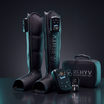
Ours is the ReHYV Pulse Pro, Rs 29,999, 4-zone sequential, 1-year India warranty with WhatsApp support. If the cost-per-use arithmetic above did not clear comfortably for you, the right conclusion is not to buy it, and we would rather say that than sell a unit that ends up in a cupboard.
Not medical advice. This page is general information, not a diagnosis or a treatment plan. Air compression massagers are recovery aids, not medical devices. If you have deep vein thrombosis or suspect it, a severe circulatory or arterial condition, uncontrolled heart failure, an active infection or open wound on the leg, a recent injury or fracture, or you are pregnant, do not use one without clearance from a doctor. Leg pain that comes on suddenly in one leg with swelling, warmth or redness needs same-day medical attention.
Frequently Asked Questions
Do compression boots actually work?
For how recovered you feel, yes — the research consistently supports reduced soreness and reduced perceived heaviness after exertion. For making you fitter, stronger or faster, no; the evidence does not support performance claims.
How often do you need to use compression boots to justify the cost?
Roughly three or four sessions a week over a few years brings the cost per session under about fifty rupees, which compares well against a single sports massage. At twice a month the arithmetic does not work and a cheaper category is the better buy.
Are compression boots better than a massage gun?
They do different jobs. Boots work the whole limb passively for twenty to thirty minutes and suit general heaviness and post-training soreness. A gun targets one muscle for a minute or two, is portable, and costs far less. Many people who train seriously own both.
How long do compression boots last?
The limiting parts are the sleeve bladders and the hoses, so the practical answer depends on whether those can be replaced. Wiping the sleeves down after use, drying them fully and storing them flat rather than sharply folded makes a real difference, since repeated creasing in one place is where bladders eventually fail.
Who should not use compression boots?
Anyone with deep vein thrombosis or a suspicion of it, severe peripheral arterial disease, active infection or an open wound on the leg, uncontrolled heart failure, a recent leg fracture or injury, or reduced sensation in the legs. Pregnancy needs medical clearance first.

Leave a comment
This site is protected by hCaptcha and the hCaptcha Privacy Policy and Terms of Service apply.