




A massage gun is active, handheld and targeted: you press it into one muscle for a minute or two, and it is the cheaper and more portable option. Compression boots are passive and whole-limb: you lie still for 20 to 30 minutes while chambers inflate in sequence, which suits general heaviness and post-training soreness. Choose a gun for a specific tight spot and boots for legs that feel heavy overall. They are complements rather than alternatives.
Key Facts
- A percussive massage gun applies targeted pressure to one muscle at a time and is used actively for one to two minutes per area.
- Compression boots apply sequential pressure to the whole limb passively over a 20 to 30 minute session.
- Massage guns are substantially cheaper and portable; compression systems are not.
- Guns should be kept off bone, joints, the neck and the front of the throat, and off any area of numbness or acute injury.
- Neither device treats a medical condition, and both are contraindicated in suspected clot and active infection.
- HYV makes a leg air compression system and does not make a massage gun.
These two get compared as if you must pick one. You do not, and people who train seriously often own both — but if the budget is for one, the choice is decided by what your legs are actually doing, not by which device is better.
The core difference
- A massage gun is active and local. You hold it against a muscle and move it slowly. One or two minutes per area. You can use it anywhere, including at the gym, and it costs a fraction of the alternative.
- Compression boots are passive and global. Sleeves go on, the pump runs a timed sequence up the limb, and you lie there for twenty or thirty minutes. It covers everything at once and it demands time and stillness.
Cost is not a subtlety here. A capable massage gun is a small fraction of a full-leg compression system. If you are unsure, the gun is the low-risk way to find out whether you are the sort of person who uses recovery tools at all.
Pick by the complaint
- "One spot in my quad is tight." Massage gun. Compression works the whole limb and cannot concentrate on a knot.
- "My legs feel heavy and dead after a long run." Compression. That is a whole-limb, fluid and fatigue sensation, and a handheld device chasing it around the leg is the wrong tool.
- "I am on my feet ten hours a day." Compression, and consider properly fitted compression stockings during the day as well.
- "I need something for the gym bag." Gun. Nothing else is portable.
- "I want to warm up before lifting." Gun, briefly, plus an actual warm-up. Some people also use a short low-pressure compression session.
- "I have a race block with hard days back to back." Compression, used consistently. This is the case where the routine matters more than the individual session.
Using each one sensibly
Massage gun: keep it on muscle, not bone or joints. Never on the front or sides of the neck. Move it continuously rather than parking it in one place, keep the pressure moderate, and stop if anything sharpens. Avoid it on acute injuries, on areas that are numb, and over varicose veins.
Compression: lie down, elevate slightly, and start lower than you think you need — a pressure that feels good for two minutes can be unpleasant at twenty. Twenty to thirty minutes is a standard session; ten to fifteen at a lower setting before training; up to forty-five to sixty after something unusually hard.
What neither of them is
Neither device treats a medical condition. Both are contraindicated where there is a suspected clot, an active infection or an open wound, and both need medical clearance where there is significant vein or artery disease or reduced sensation. If the reason you are shopping is pain rather than post-exertion heaviness, the useful spend is a consultation, not a device.
What you get for the money in each category
Worth being blunt about, because the two categories scale very differently as you spend more.
- Massage guns improve mostly in motor quality, noise, battery life and stall force — how much pressure you can apply before the head stops moving. Beyond a certain point the gains are small, and the cheap end of the market is genuinely usable. This is a category where spending a lot is optional.
- Compression systems improve in ways that change what the device does at all: simultaneous inflation becomes sequential, two zones become four, a vague intensity dial becomes a published pressure range, and sleeve build quality changes how long the thing survives. Here the money buys capability rather than refinement.
That asymmetry is the practical reason to start with a gun. An entry-level gun is a real version of the tool. An entry-level compression unit is often a different tool wearing the same name.
A routine that uses both
If you end up with both, the order that most people settle on:
- Before training: a minute or two with the gun on the muscles you are about to load, as part of a warm-up rather than instead of one.
- Straight after: nothing. Eat, drink, get changed. There is no urgency here that the marketing implies.
- Later that evening: a compression session with the legs up, twenty to thirty minutes, at a pressure you would tolerate for the whole time.
- The next day, if one area is still sharp: the gun, on that area only.
The routine matters more than either device. Consistency is what people who feel the benefit have in common; equipment is what people who do not feel it tend to focus on.
Disclosure
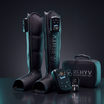
HYV makes a leg air compression system — the ReHYV Pulse Pro, Rs 29,999, 4-zone sequential, 1-year India warranty. We do not make a massage gun and have nothing to sell you if the gun is the right answer, which is roughly half the time. That is why the recommendations above go both ways.
Not medical advice. This page is general information, not a diagnosis or a treatment plan. Air compression massagers are recovery aids, not medical devices. If you have deep vein thrombosis or suspect it, a severe circulatory or arterial condition, uncontrolled heart failure, an active infection or open wound on the leg, a recent injury or fracture, or you are pregnant, do not use one without clearance from a doctor. Leg pain that comes on suddenly in one leg with swelling, warmth or redness needs same-day medical attention.
Frequently Asked Questions
Should I buy a massage gun or compression boots first?
A massage gun, in most cases. It costs a fraction as much, is portable, and it tells you whether you are someone who actually uses recovery tools. Move to compression when the complaint is whole-leg heaviness rather than a specific tight spot.
Can you use a massage gun and compression boots together?
Yes, and many people who train seriously do. A common pattern is the gun on specific tight areas and a compression session afterwards for general heaviness.
Which is better for DOMS?
Compression suits the general, diffuse soreness of delayed-onset muscle soreness because it covers the whole limb. A gun helps where the soreness has concentrated in one area. Neither shortens the underlying process much; both make the days more comfortable.
Where should you not use a massage gun?
Off bone and joints, off the front and sides of the neck, off the head and face, away from acute injuries, away from any area with numbness or reduced sensation, and not over varicose veins. Keep it moving rather than holding it in one spot.
Does HYV sell a massage gun?
No. HYV makes the ReHYV Pulse Pro leg air compression system only. If a massage gun is the right tool for your problem, we do not have a product to sell you.

Leave a comment
This site is protected by hCaptcha and the hCaptcha Privacy Policy and Terms of Service apply.