




They help with how sore you feel, and that is a narrower claim than the marketing makes. Studies on intermittent pneumatic compression consistently find improvements in perceived soreness after hard training. Studies looking at performance recovery — power, strength, time to exhaustion the next day — show much smaller and less consistent effects. So compression boots are a reasonable tool for feeling less wrecked. They are not a way to train harder than you have recovered from.
Key Facts
- DOMS is soreness peaking roughly 24 to 72 hours after unfamiliar or eccentric-heavy work.
- Research on compression most consistently shows improvement in perceived soreness.
- Effects on next-day performance markers are smaller and less consistent.
- Sleep, protein intake and easy movement remain the largest recovery levers.
- Air compression is contraindicated in suspected clot, severe arterial disease, active infection, uncontrolled heart failure and reduced sensation.
DOMS — delayed onset muscle soreness — is the stiffness that arrives a day after unfamiliar work and peaks somewhere between 24 and 72 hours. Eccentric loading produces it most reliably: downhill running, the lowering half of a lift, anything your legs are not used to.
What compression does about it
Intermittent pneumatic compression assists venous return while it runs, which helps move fluid out of a limb that has swollen slightly in response to work. The soreness of DOMS is not purely swelling, but the heavy, tight, congested feeling that accompanies it responds to that fluid shift.
On the evidence, plainly: most research here measures how sore people report feeling, which is a real outcome and a soft one. Studies that look at performance markers — power output the next day, strength recovery — show much smaller and less consistent effects. So the defensible claim is that compression tends to make legs feel better afterwards. Anyone telling you it measurably rebuilds tissue faster is ahead of what has been shown.
That distinction is the whole answer to this question. "My legs feel better" is a genuine outcome worth paying for — feeling less sore makes the next session more likely to happen and more pleasant when it does. It is simply not the same as "my muscles have repaired faster", and the category routinely blurs the two.
What DOMS actually is, since the usual explanation is wrong
The lactic acid story is still repeated everywhere and it is not right. Lactate clears within about an hour of finishing; soreness that peaks a day or two later cannot be caused by something that left before you got home.
What is happening is microscopic damage to muscle fibres from eccentric loading — the lengthening-under-tension part of a movement — followed by an inflammatory response that sensitises the area. That is why the lowering half of a lift, downhill running and any unfamiliar movement produce it most reliably, and why the same session stops causing it once you have repeated it a few times.
It matters here because it explains the limits. A device that moves fluid can address the congested, heavy component of how that feels. It is not reaching the fibre damage itself, and nothing you can buy does.
What helps more than a device
If you have DOMS and are choosing where to put effort, a device is not the first lever.
- Sleep. Nothing else on this list is close. The recovery that matters happens there.
- Protein and total calories. Under-eating while training hard produces exactly the fatigue people try to fix with gadgets.
- Easy movement. A walk or an easy spin does more for stiff legs than lying still does, and it is free.
- Progression that fits. DOMS this severe every week is usually a programming message rather than a recovery problem.
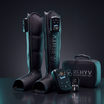
Compression sits after those, as something that makes the next 48 hours more comfortable. That is a fair reason to own one — our ReHYV Pulse Pro is sold on exactly that basis — and it is not a reason to expect it to change what your training can absorb.
How to use it for DOMS specifically
Run a session within a few hours of the work that caused it, and again the following day if the soreness is significant. Twenty to thirty minutes, moderate pressure. Sore muscles are more sensitive than usual, so a setting that felt fine last week may feel sharp today — go lower rather than pushing through, because tensing against the sleeve is counterproductive.
When soreness is not DOMS
DOMS is diffuse, affects the whole muscle group, arrives with a delay and eases with gentle movement. Pain that is sharp, localised to one point, present during the activity, or on one side only is a different thing and deserves attention rather than a recovery protocol. Swelling in one leg with warmth or redness is not soreness at all and needs to be seen the same day.
When not to use one
None of this applies if compression is unsafe for you, and the people most likely to buy a recovery device unprompted are disproportionately on this list. Do not use an air compression device — and speak to a doctor — with any suspicion of a deep vein thrombosis (sudden swelling in one leg with warmth, redness or calf pain is a same-day medical problem, because a compressed clot can travel), severe peripheral arterial disease, an active infection, cellulitis or an open wound under the sleeve, uncontrolled heart failure, a recent fracture or leg surgery, reduced sensation including diabetic neuropathy, or during pregnancy without clearance.
Frequently Asked Questions
Do compression boots help with DOMS?
They reliably reduce how sore you feel. Effects on next-day performance markers are smaller and less consistent.
Do compression boots speed up muscle repair?
That is beyond what has been shown. The consistent finding is improvement in perceived soreness.
What helps DOMS more than compression boots?
Sleep, adequate protein and calories, easy movement, and training progression that fits what you can absorb.
When should I use them for DOMS?
Within a few hours of the session that caused it, and again the next day if soreness is significant. Use a lower pressure than usual — sore legs are more sensitive.

Leave a comment
This site is protected by hCaptcha and the hCaptcha Privacy Policy and Terms of Service apply.