





They are worth it for riders doing consecutive hard days — stage events, big training blocks, or back-to-back long rides — where the goal is turning up tomorrow with legs that work. For a rider training three or four times a week with rest days between, the benefit is real but small, and the money is usually better spent on a bike fit or coaching. Cycling loads legs in a way compression suits, because long saddle time produces heavy, congested legs without the impact damage running causes.
Key Facts
- Cycling produces congestion and fatigue with relatively little eccentric muscle damage.
- The strongest case is consecutive hard days, where tomorrow’s ride matters more than adaptation.
- Compression assists venous return; it does not repair tissue or replace sleep and fuelling.
- A typical session is 20 to 30 minutes at a moderate pressure.
- Air compression is contraindicated in suspected clot, severe arterial disease, active infection, uncontrolled heart failure and reduced sensation.
Cyclists adopted these devices earlier and more enthusiastically than most other athletes, and it is worth asking whether that was fashion or fit. It was mostly fit — cycling produces exactly the kind of leg fatigue compression is decent at.
Why cycling suits compression specifically
Running is eccentric. Every stride is a controlled landing, and the muscle damage that produces is the main driver of next-day soreness. Cycling is almost entirely concentric — you push, you do not absorb impact — so a hard ride leaves you fatigued and congested rather than damaged in the same way.
That distinction matters because compression is good at the congestion and has nothing to say about fibre damage. The heavy, full, slightly swollen feeling after four hours in the saddle is precisely the complaint it addresses, which is why riders tend to report a clearer benefit than lifters do.
Long saddle time also means long periods in a fixed position with limited calf-muscle pumping. Legs get heavy partly for postural reasons rather than purely from effort — again, something a squeeze-and-release cycle helps with.
Where it genuinely earns its place
Stage events and consecutive hard days. The clearest case. When tomorrow's ride is the point, feeling less wrecked tonight has direct value and any adaptation question is secondary.
Big training blocks. Weeks with back-to-back long rides, where the accumulated heaviness is what limits the next session rather than any single ride.
After long travel to an event. Hours in a car or plane before a ride produce the same congestion, and a session on arrival is a reasonable use.
Where the money is better spent
If you ride three or four times a week with rest days between, be honest about the marginal benefit. A rider in that pattern is usually recovered by the next session anyway, and the things that would make more difference are unglamorous: a proper bike fit, eating enough on long rides, sleeping, and a training plan that progresses sensibly.
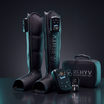
We sell one of these devices — the ReHYV Pulse Pro at ₹29,999 — and it is still the wrong first purchase for a rider who has not had a bike fit. Saddle and cleat position affect how your legs feel far more than any recovery tool.
Compression on the bike is a different thing
Worth separating, because cyclists meet both. Compression socks and sleeves worn while riding are a different proposition from a recovery device used afterwards — the evidence for performance benefit during exercise is weak and contested, while the case for post-exercise compression is the more solid one.
So if you are deciding where to spend, the recovery use is the better-supported end. Riding in calf sleeves because they look professional is a choice, not a training intervention.
Coverage: calves or full leg
Worth checking before buying as a cyclist. Some systems sleeve the calf and lower leg only; others run to the thigh and hip. Cycling loads the quads heavily, so a calf-only device is addressing part of the complaint.
That said, the heaviness riders most often describe sits in the calves and the fluid congestion is most pronounced distally, so calf-and-lower-leg coverage does the majority of the useful work. Full-leg systems cost considerably more, and whether that difference matters depends on whether your quads or your calves are what feel wrecked after a long ride. Be honest about which it actually is rather than buying the larger device by default.
Fitting it into a week
Twenty to thirty minutes after the ride, or in the evening. On back-to-back days, after the first ride matters more than after the last one. Moderate pressure — cycling legs are often more sensitive than they feel, especially in the calves after a lot of climbing.
One rider-specific note: if you have persistent one-sided leg symptoms, do not treat that as a recovery problem. Asymmetry in cycling usually points at fit or mechanics, and any new one-sided swelling or calf pain needs assessing rather than compressing.
When not to use one
Do not use an air compression device — and speak to a doctor — with any suspicion of a deep vein thrombosis (sudden swelling in one leg with warmth, redness or calf pain needs same-day attention, because a compressed clot can travel), severe peripheral arterial disease, an active infection, cellulitis or an open wound under the sleeve, uncontrolled heart failure, a recent fracture or leg surgery, reduced sensation including diabetic neuropathy, or during pregnancy without clearance.
Frequently Asked Questions
Are compression boots worth it for cyclists?
Most on consecutive hard days — stage events and big blocks. For three or four rides a week with rest days between, the benefit is small and a bike fit matters more.
Why do compression boots suit cycling?
Cycling produces congestion and heaviness with relatively little eccentric damage, and congestion is what compression addresses.
When should a cyclist use them?
After the ride or in the evening, 20 to 30 minutes at moderate pressure. On back-to-back days, the session after the first ride matters most.
What should a cyclist buy before a recovery device?
A proper bike fit. Saddle and cleat position change how legs feel far more than any recovery tool.

Leave a comment
This site is protected by hCaptcha and the hCaptcha Privacy Policy and Terms of Service apply.