




Set it by feel, not by number. A useful session is firm, steady and slightly boring — a pressure you stop noticing within a couple of minutes. As a starting point, most people land somewhere in the middle of a device’s range and work down rather than up. Published mmHg figures are close to useless for comparing brands because they are measured at different points, in different ways, and almost never independently verified. Higher is not a stronger dose; past a point it makes you tense against the sleeve, which works against the purpose.
Key Facts
- mmHg figures are not comparable across brands — measurement points and methods differ.
- Correct pressure is firm and unremarkable, not something you endure.
- Tensing against high pressure works against the venous return you are trying to assist.
- Numbness, tingling or marks that do not fade quickly all mean the pressure is too high.
- Air compression is contraindicated in suspected clot, severe arterial disease, active infection, uncontrolled heart failure and reduced sensation.
Every device in this category advertises a peak pressure, and buyers reasonably assume a higher number means a better machine. It is the least useful specification on the listing, and understanding why also tells you how to set your own.
Why the numbers do not compare
A pressure figure depends entirely on where and how it was measured. Pressure at the pump is not pressure inside the chamber, and pressure inside the chamber is not pressure at the skin — which is what your leg experiences and which varies with limb size, sleeve fit and how much air the chamber holds.
Manufacturers measure at different points, publish peak rather than sustained figures, and are almost never independently verified. Two devices both claiming 240 mmHg can deliver noticeably different sensations to the same leg. Treat the number as a rough family resemblance, not a specification.
How to set it properly
Start mid-range and come down. Most people set too high on the first session because the sensation is novel. Run a few minutes, then reduce until you notice the squeeze less.
Aim for boring. If you can read through the session without thinking about your legs, it is right. If you are counting cycles until it releases, it is too high.
Adjust for the day. Sore legs are more sensitive. A setting that was comfortable last week can feel sharp after a heavy session — that is normal and means going lower, not pushing through.
Check the fit first. Much of what people experience as "too much pressure" is a sleeve that is too tight or badly positioned for their calf. Pressure and fit produce similar complaints and have different fixes.
The signs you have it wrong
- Numbness or pins and needles during a cycle — reduce immediately.
- Legs aching after rather than feeling lighter — too high, too long, or both.
- Deep marks that persist more than a few minutes after the sleeve comes off.
- Bracing. If you are tensing your calves against the squeeze, you are working against the mechanism. That is the clearest sign of all and the easiest to miss, because it feels like effort rather than error.
Pressure and time are one dial, not two
People tune these separately and they interact. A higher pressure at twenty minutes and a moderate pressure at thirty are not the same session, and the second is generally the better one — more cycles at a level you tolerate beats fewer cycles you are enduring.
If a session felt like too much, reduce pressure before you shorten the session. The number of squeeze-and-release cycles is where the benefit accumulates, so cutting time is the more costly adjustment of the two.
If your device only has presets
Many devices offer modes rather than a pressure number — three or four levels, sometimes with named programmes. The approach is the same: start in the middle, run a few minutes, and step down if you are still noticing it. Named programmes usually differ in cycle pattern rather than intensity, so they are worth trying but are not a substitute for getting the level right.
Graduated versus uniform
A related question worth separating. Medical graduated compression stockings apply a pressure gradient that is highest at the ankle and decreases up the leg, worn continuously and fitted to a clinician-chosen class. A recovery device applies intermittent cycles, usually sequenced ankle-upward, at whatever level you select.
Both get called compression and they are doing different jobs. If a clinician has prescribed a compression class for a vein condition, a recovery device is not a substitute for it and the prescribed pressure figure does not transfer to your device settings.
A practical starting protocol
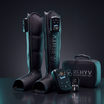
Mid-range pressure, twenty minutes, legs supported rather than dangling. Reduce if you notice it after the first few minutes. Our own ReHYV Pulse Pro is built around that pattern, and so is essentially every credible device — the protocol matters more than which machine is running it.
When not to use one
Do not use an air compression device — and speak to a doctor — with any suspicion of a deep vein thrombosis (sudden swelling in one leg with warmth, redness or calf pain needs same-day attention, because a compressed clot can travel), severe peripheral arterial disease, an active infection, cellulitis or an open wound under the sleeve, uncontrolled heart failure, a recent fracture or leg surgery, reduced sensation including diabetic neuropathy, or during pregnancy without clearance.
Frequently Asked Questions
What pressure should compression boots be set to?
One that feels firm and unremarkable — you should stop noticing it within a couple of minutes. Start mid-range and work down rather than up.
Are mmHg numbers comparable between brands?
No. They are measured at different points and methods and rarely independently verified, so two devices claiming the same figure can feel quite different.
Is higher pressure more effective?
No. Past a comfortable level you tense against the sleeve, which works against the venous return you are trying to assist.
Can I use my prescribed stocking pressure as a setting?
No. Graduated stockings apply continuous fitted pressure for a different purpose; the figure does not transfer to an intermittent recovery device.

Leave a comment
This site is protected by hCaptcha and the hCaptcha Privacy Policy and Terms of Service apply.