




The Caresmith Leg Compression Massager is ₹9,999 and the ReHYV Pulse Pro lists at ₹29,999 and is ₹23,999 after its automatic checkout reward, so this is roughly a two-and-a-half-times price decision rather than a close call. The useful question is what the gap buys: four-zone sequential compression, a 240 mmHg range across seven levels, roughly 120 minutes cordless, independent legs and a one-year India warranty, against a listing that matches the zone count and the pressure ceiling but lists a single controller, no cordless operation and no carry case. If those specifics do not matter to you, the cheaper device is the rational buy and we would rather say so.
Key Facts
- Caresmith Leg Compression Massager lists at ₹9,999; the ReHYV Pulse Pro at ₹29,999 list, ₹23,999 paid after the automatic 20% checkout reward.
- ReHYV publishes 4-zone sequential compression, 240 mmHg maximum and 7 pressure levels.
- Caresmith’s Amazon listing publishes four named zones, eight intensity levels spanning 20 to 240 mmHg, four modes and 10, 20 or 30 minute timers.
- Compression eases exertion-related heaviness; it does not treat a medical condition.
- Air compression is contraindicated in suspected clot, severe arterial disease, active infection, uncontrolled heart failure and reduced sensation.
We make one of these two, which you should weigh as you read. What follows is what each company publishes, with prices read on 25 September 2026.
Three things the Caresmith listing does not have
Start here, because this is where the two machines actually diverge. Each of these is checkable against their own Amazon listing rather than asserted.
Two controllers, one per leg. The Caresmith Revive is sold "with Powerful Controller" — singular. The ReHYV Pulse Pro ships a controller for each leg, each with its own full-colour LCD, and the legs run independently. That matters more than it sounds: it means you can run a heavier pressure on the leg that needs it, or run one leg at all, which anyone rehabbing a single-side niggle will understand immediately.
Up to 120 minutes cordless. The Caresmith listing does not claim cordless operation anywhere. The ReHYV Pulse Pro runs about two hours off a charge, which is the difference between a device that lives where the socket is and one you use on the sofa, in bed or in a hotel room.
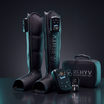
A carry case. There is no mention of a case, bag or pouch anywhere in the Caresmith listing. ReHYV ships a branded carry case in the box, along with the pair of sleeves, the two controllers, the wireless remote, the power adapter and cables, and a quick-start card. If the machine travels — to a gym, a match, a hotel — this is the thing that decides whether it travels at all or stays in a cupboard.
Where the two are level: both publish four zones and a 240 mmHg ceiling, and Caresmith lists eight pressure levels to ReHYV’s seven. We would rather tell you that than have you find it on their listing and stop trusting the rest of this page.
Price, first
The Caresmith Leg Compression Massager lists at ₹9,999. Caresmith also sells a Leg & Arm version at ₹13,499. The ReHYV Pulse Pro is ₹29,999. That is roughly three times the price, and no amount of specification talk makes that difference small. If your budget is the deciding factor, the decision is already made and the rest of this page is optional reading.
What each product page tells you
The clearest difference between these two is not a feature — it is how much you are told before you buy.
ReHYV publishes: four overlapping air chambers per sleeve running a sequential cycle up the leg, a maximum of 240 mmHg across seven pressure levels, roughly 120 minutes of cordless operation, each leg running independently, a wireless remote and LCD, and a one-year India warranty with WhatsApp support.
Caresmith's leg compression listing describes relaxing muscles, reviving tired legs and post-workout recovery. Its Amazon listing does publish a zone count, a pressure range and session lengths, and on the spec floor the two machines are closely matched. That is a statement about the listing, not about the device — we have not tested a Caresmith unit and will not pretend to have. But if you want to compare two devices on anything other than price, one of them has to give you numbers.
Why zones and mmHg actually matter
A single-chamber or two-chamber sleeve inflates broadly. A four-zone sleeve inflates in sequence from the foot upward, which is the pattern that assists venous return rather than simply squeezing the limb. It is the difference the whole category is built on, and it is worth knowing which one you are buying.
Pressure range matters for a duller reason: most people settle well below a device's maximum, and a range with fine steps means you can find a setting you will actually use for twenty minutes. A device with two settings, both too strong, gets used twice.
On the evidence, plainly: most research here measures how sore people report feeling — a real outcome and a soft one. Studies looking at next-day power output or strength recovery show smaller, less consistent effects. The defensible claim is that compression tends to make legs feel better afterwards. That is true at ₹3,589 and at ₹1,04,990.
When the Caresmith is the better buy
If you want your legs to feel less heavy after standing all day, you are not training seriously, and ₹20,000 of difference is real money to you — buy the cheaper device. The mechanism is the same, the evidence base is the same, and a device you actually own beats a better one you did not buy. We would rather you spent ₹9,999 well than ₹29,999 on specifications you will never adjust.
When the ReHYV is
If you train hard enough to care about what happens to your legs afterwards, want to set pressure precisely and keep the thing for years, or want a warranty and a person to message when something fails, the specified device is the one to buy. That is the argument, and it is the whole argument — it is not a claim that our device outperforms one we have not tested.


What to settle before either
Measure your calf and thigh at the widest point against the sleeve range. Ask both sellers what a replacement sleeve costs and who fits it. Check whether the unit runs cordless if you want to use it away from a socket. Those three answers will separate these devices more usefully than any comparison page, including this one.
When not to use one — the contraindications
Air compression is contraindicated in several conditions, and none of this matters if it is unsafe for you. Do not use one — and speak to a doctor — with any suspicion of a deep vein thrombosis (sudden swelling in one leg with warmth, redness or calf pain is a same-day medical problem, because a compressed clot can travel), severe peripheral arterial disease, an active infection, cellulitis or an open wound under the sleeve, uncontrolled heart failure, a recent fracture or leg surgery, reduced sensation including diabetic neuropathy, or during pregnancy without clearance.
We go into this properly in how they compare.
Frequently Asked Questions
Is the ReHYV Pulse Pro better than the Caresmith leg massager?
Not on the spec floor — both publish four zones and a 240 mmHg maximum, and Caresmith lists eight pressure levels against ReHYV’s seven. ReHYV adds three things the Caresmith listing does not carry: two controllers, one per leg, each with a full-colour LCD; up to 120 minutes of cordless use; and a branded carry case. We have not tested a Caresmith unit, so we will not claim ours performs better; we will say ours is specified and the price reflects that.
How much does the Caresmith leg compression massager cost?
₹9,999 on Amazon in September 2026. The Leg & Arm version is ₹13,499.
Is three times the price worth it?
Only if the specifics matter to you — precise pressure control, sequential four-zone compression, cordless use and a local warranty. If they do not, the cheaper device is the rational choice.
What does four-zone sequential mean?
Four overlapping chambers inflate in order from the foot upward rather than squeezing the whole limb at once. That sequence is what assists venous return, and it is the principle the category is built on.
Will either help with varicose veins?
Compression can ease the aching and heaviness varicose veins cause, by assisting venous return. Neither device repairs a valve or removes a vein, and compression is unsafe in several conditions. See a vascular specialist for the condition itself.

Leave a comment
This site is protected by hCaptcha and the hCaptcha Privacy Policy and Terms of Service apply.