






Leg pain relief depends entirely on the cause. Muscle soreness after exertion eases with movement, warmth and time. Heaviness from long standing responds to elevation, walking and compression. Cramps often relate to hydration, fatigue or minerals. Nerve pain, arterial pain and clot pain need medical assessment, not self-treatment. Sudden one-sided swelling with warmth or redness, calf pain that appears while walking and stops at rest, or leg pain with breathlessness all need a doctor rather than a device.
Key Facts
- Leg pain is a symptom with many unrelated causes; effective relief depends on identifying which one applies.
- Delayed-onset muscle soreness peaks roughly 24 to 72 hours after unfamiliar exertion and resolves on its own.
- Cramping calf pain that starts while walking and stops with rest suggests arterial claudication and needs assessment.
- Sudden swelling in one leg with warmth, redness or pain is a possible deep vein thrombosis and is a medical emergency.
- Burning, tingling or shooting pain usually indicates a nerve cause, such as sciatica or a peripheral neuropathy, rather than a muscle one.
- Compression devices are useful for exertion-related heaviness and soreness, and are contraindicated in clot, arterial disease and active infection.
"Leg pain" covers a dozen unrelated problems, which is why generic remedies disappoint so often. A pain killer, an oil and a massager are three answers to three different questions, and buying the wrong one is the usual outcome. Work out which kind of pain you have first.
First: the signs that mean see a doctor, not a shop
Deal with these before anything else on this page.
- Sudden swelling in one leg, with warmth, redness or calf tenderness. Possible deep vein thrombosis. Same-day medical attention. Do not massage or compress it.
- Leg pain with chest pain or breathlessness. Emergency.
- Cramping calf pain that reliably begins after walking a certain distance and stops when you stand still. This pattern suggests arterial disease, and it is important because it is a marker of cardiovascular risk more broadly.
- Fever with a hot, red, tender area — possible cellulitis, needs antibiotics.
- Numbness, marked weakness, or loss of bladder or bowel control alongside leg pain. Urgent.
- Pain after significant trauma, or pain that will not let you bear weight.
- An ulcer or a break in the skin that is not healing.
Muscle soreness after exertion
The familiar one: stiff, tender legs a day or two after a hard session, a long run or unfamiliar work. Delayed-onset muscle soreness peaks somewhere around 24 to 72 hours and clears on its own. It responds to gentle movement rather than complete rest, warmth, sleep and food. Compression, warm baths and light activity make the days more comfortable; nothing meaningfully shortens the process, and claims otherwise should be treated with suspicion.
Heavy, aching legs from standing or sitting
Common in retail, healthcare, hospitality, teaching, long commutes and long flights. The mechanism is venous: blood and tissue fluid pool when the calf muscle pump is idle. It typically worsens through the day and eases overnight.
What helps: walking, breaking up long stretches of standing or sitting, ankle pumps and calf raises, elevating the legs in the evening, and compression. This is the pattern that intermittent compression is genuinely well suited to — it is doing mechanically what walking does naturally. If the ache is accompanied by visible veins or ankle swelling that does not settle overnight, read our page on varicose veins in the legs, because the management is different.
Cramps
Sudden, seizing, usually calf or foot, often at night. Stretch into it — pull the toes toward you with the knee straight — rather than fighting it. Frequent cramps are worth looking at in terms of hydration, overall fatigue and training load, and are sometimes linked to medications or to mineral levels, which is a conversation with a doctor rather than a guess. Cramps that are severe, very frequent, or accompanied by weakness deserve assessment.
Nerve pain
Burning, tingling, electric or shooting pain, often travelling in a line down the leg, sometimes with numbness. Sciatica from the lower back is the common one; peripheral neuropathy, frequently diabetic, is the other. Massage and compression are not the answer here and compression can be inadvisable where sensation is reduced, because you cannot judge the pressure reliably. This needs a proper diagnosis.
Joint and tendon pain
Knee, hip and ankle pain often present as "leg pain". So do shin splints and Achilles problems in runners. These are load and technique problems as much as tissue problems, and they respond to graded loading and physiotherapy rather than to a device.
Where a compression device fits
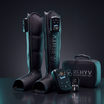
Honestly and narrowly: for exertion-related soreness and for the heavy-legged feeling that comes from long days upright. In those two situations, twenty to thirty minutes of intermittent compression with the legs up is comfortable and useful, and that is what our ReHYV Pulse Pro is built for.
It is not a treatment for nerve pain, joint pain, arterial pain or a clot. For several of those it is actively contraindicated. If you do not know which category your pain falls into, that uncertainty is the reason to see a doctor rather than a reason to try a device and find out.
Not medical advice. This page is general information, not a diagnosis or a treatment plan. Air compression massagers are recovery aids, not medical devices. If you have deep vein thrombosis or suspect it, a severe circulatory or arterial condition, uncontrolled heart failure, an active infection or open wound on the leg, a recent injury or fracture, or you are pregnant, do not use one without clearance from a doctor. Leg pain that comes on suddenly in one leg with swelling, warmth or redness needs same-day medical attention.
Frequently Asked Questions
What is the fastest way to relieve leg pain?
It depends on the cause. Exertion soreness eases with gentle movement, warmth and sleep. Heaviness from standing eases with elevation, walking and compression. A cramp eases with a sustained stretch. Nerve, arterial and clot-related pain need medical assessment, and treating them with heat or massage can make things worse.
When should I worry about leg pain?
Sudden swelling in one leg with warmth or redness, leg pain with breathlessness or chest pain, calf pain that starts while walking and stops at rest, fever with a hot red area, or numbness and weakness — all need prompt medical attention.
Does a leg massager help with leg pain?
For soreness after exercise and for heavy legs after long periods standing, intermittent compression is comfortable and useful. For nerve pain, joint pain, arterial disease or a suspected clot it does not help and may be unsafe.
Why do my legs ache at the end of every day?
Usually venous pooling from long periods standing or sitting, since the calf muscle pump that returns blood upward is idle. It typically improves overnight. If it comes with ankle swelling that persists or with visible veins, it is worth having the veins assessed.
What causes leg cramps at night?
Often fatigue, dehydration or heavy training load, and sometimes medications or mineral levels. Occasional cramps are common and not concerning. Frequent or severe cramps, especially with weakness, should be discussed with a doctor.

Leave a comment
This site is protected by hCaptcha and the hCaptcha Privacy Policy and Terms of Service apply.