












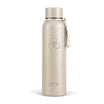


















An insulated bottle keeps drinks cold or hot for hours using a vacuum sealed between two steel walls — not electronics. In India’s heat, it’s the single kitchen upgrade with the biggest daily payoff.
Key Facts
- Vacuum insulation removes conduction and convection without power; a reflective inner wall handles most of the rest.
- Same bottle keeps cold water cold and hot chai hot.
- HYV makes BIS-certified bottles. IS 17526:2021 is India’s standard for stainless steel vacuum insulated bottles.
- HYV bottles range 750 ml to 2 L with different lid styles for different use cases.
- Insulated bottles pay back their price in months by replacing single-use plastic.
HYV picks, with the actual product
Three models worth looking at for this, photographed as they ship. Prices are the direct price on livehyv.com.


Shop HYV insulated water bottles →
Free shipping on orders over ₹499 · 7-day free replacement for product issues. HYV makes BIS-certified bottles.
Why insulated wins in India
40°C summers and monsoon humidity destroy plain steel and plastic bottles. Insulated steel doesn’t care about ambient temperature.
What to check
- Vacuum (not just double-wall).
- Food-grade 304 steel.
HYV’s range
Different lids for different use cases. Read the 2026 buying guide.
What actually changes on day one
The case for an insulated bottle is usually made with retention specifications. What people notice is smaller and more immediate.
- Nothing sweats. A vacuum bottle stays dry on the outside, so no rings on documents, no damp patch in the bag, no puddle on the bedside table. This is the change people mention first, and it is never in the marketing.
- Water at 4pm tastes like water at 9am. Warm water is not unsafe, it is unappealing, and unappealing water goes undrunk. This is the actual mechanism by which an insulated bottle increases how much you drink.
- Ice survives the commute. Which matters in an Indian summer far more than an extra hour of quoted retention.
Cost per use, which is the honest frame
A ₹1,200 certified bottle used daily for three years costs roughly a rupee a day. Set against buying a ₹20 packaged bottle even twice a week, it pays for itself in about four months and saves money every day after.
The comparison people actually make — ₹1,200 against a ₹300 bottle — is the wrong one, because the ₹300 bottle is usually replaced two or three times in the same period once it scratches and starts to smell. The relevant question is cost per year of comfortable use, and on that measure the cheap bottle is rarely cheaper.
When you genuinely do not need one
An honest case has an exception list.
- You are always beside a cooler or a fridge. If a cold refill is thirty seconds away, insulation is solving a problem you do not have. A light single-wall steel bottle is the better buy.
- You drink it within an hour of filling. Insulation is irrelevant on that timescale.
- Weight is your binding constraint — long hikes, running, cycling. Two steel walls are heavy, and there are lighter answers built for those uses.
- You lose bottles. Buy cheap ones until that stops being true. This is not a joke; it is the most common reason an expensive bottle turns out to be a bad purchase.
See also: Stainless Steel Coffee Mug: The Everyday Case for One.
The arithmetic, done honestly
The payback case for an insulated bottle is usually made badly, with a spreadsheet that assumes you would otherwise buy bottled water every single day. Most people would not. Here is the version that survives scrutiny.
A packaged litre of water bought on the move in an Indian city typically runs ₹20 to ₹40 depending on where you buy it. If you genuinely buy one on three days a week, that is roughly ₹60 to ₹120 a week, so an insulated bottle at ₹1,699 pays for itself somewhere between four and seven months. If you buy packaged water twice a month, it never pays for itself on those terms and you should buy it for the other reasons instead.
The other reasons are real and worth stating plainly: cold water you actually want to drink, not carrying plastic, and not having the decision at all. Those are the honest arguments. The cost argument only works if you were really buying packaged water, and it is worth checking whether you were.
Why people stop using them
The bottle almost never fails. The habit does, and it fails in four predictable ways — all of which you can avoid at purchase.
It does not fit. Cup holder, bag pocket, or the side of a backpack. Measure first; this is the most common cause and the easiest to prevent.
The lid annoys you. Twenty interactions a day with a mechanism you find fiddly ends the relationship by week three. Pick the lid you will tolerate rather than the one that demos well.
It started to smell. Almost always the gasket, and almost always because the lid was never taken apart. A cap that cannot be dismantled cannot be cleaned, which is worth knowing before buying rather than after.
It became a chore to wash. Narrow necks and complicated straws need a brush and patience. If you will not do that, buy a wide-mouth bottle and a simpler lid and accept the trade.
What it is worth spending
Below roughly ₹500, vacuum insulation in India is usually not genuine whatever the listing states, and you are buying a double-walled cup with a good photograph. Between about ₹900 and ₹1,700 is where properly made double-wall vacuum bottles sit — HYV CoreFlow at ₹899, LuxeSip and LuxeFlow at ₹1,699. Above roughly ₹1,500 the additional money buys design, lid engineering and brand rather than materially better insulation.
The sensible ceiling for most people is whatever the certified tier costs, plus whichever lid they will actually use daily. Spending past that is a preference, not a performance decision, and it is fine as long as you know which one you are making.
Frequently Asked Questions
Is an insulated bottle worth it?
In India, yes — it’s the difference between water you drink and water you avoid.
How long does an insulated bottle last?
Many years. The lid gasket wears before the body.
Are insulated bottles microwave safe?
No — steel bottles are not microwave safe.


Leave a comment
This site is protected by hCaptcha and the hCaptcha Privacy Policy and Terms of Service apply.