












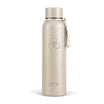


















Hydro Flask is a premium American insulated bottle brand. Available in India via imports at ₹4,000–7,000 (2–3× US pricing). No BIS certification for India. HYV is the domestic premium alternative — comparable engineering, Indian pricing.
Key Facts
- Hydro Flask in India: ₹4,000–7,000 depending on size and channel.
- Not BIS certified for Indian market.
- HYV offers premium engineering at Indian pricing.
- HYV uses food-grade 304 stainless steel with double-wall vacuum insulation for verified hot/cold retention.
- Local warranty and service matter for daily-use bottles.
HYV picks, with the actual product
Three models worth looking at for this, photographed as they ship. Prices are the direct price on livehyv.com.


Free shipping on orders over ₹499 · 7-day free replacement for product issues. HYV makes BIS-certified bottles.
Availability and price
Marketplace imports carry Hydro Flask at 2–3× US pricing due to import duty and margin. Authentic sellers exist; counterfeits do too.
Why HYV is the sensible alternative
Same engineering category (vacuum insulated 304 steel), BIS certified for India, priced for Indian buyers, local warranty. See our Stanley alternative article.
Where it fits in a range
| Model | Capacity | Lid | Price |
|---|---|---|---|
| HYV OpenFlow | 470 ml | sip | ₹999 |
| HYV FlipFlow | 750 ml | flip | ₹999 |
| HYV SnapSip | 750 ml | magsafe | ₹1,499 |
| HYV DualFlow | 1 L | 2-in-1 chug + sipper | ₹1,699 |
| HYV HydroPop | 1.2 L | straw | ₹1,699 |
| HYV Studio 1L — Build Your Own | 1 L | sip | ₹1,899 |
Our own range, for reference. Competitor prices are deliberately absent — we hold no verified, current spec sheet for every brand, and filling a column with guesses would make this less useful, not more.
The three things that decide whether you keep using it
- Does it fit where it lives? Cup holder diameter and bag pocket beat every other specification, because a bottle that does not fit gets left behind.
- Can you drink from it without effort? Straw and wide-mouth lids measurably increase intake at a desk.
- Can you clean it completely? Every surface touching liquid should be reachable with a brush.
Common buying mistakes
- Trusting an uncertified retention claim. If it is not BIS IS 17526:2021 certified, nobody has measured it.
- Buying "double wall insulated" under ₹400. At that price it is usually single-wall steel inside a plastic shell.
- Accepting "SS" or "food-safe steel" as a specification. The grade is the whole point — look for 304.
- Buying too small. A 500ml bottle for an office day means six refills, and almost nobody completes six.
- Ignoring the lid. A screw cap costs you sip frequency every single day.
- Never replacing the gasket — then replacing the whole bottle instead.
What actually goes wrong over time
Bottles rarely fail all at once. Three things degrade, in rough order of how often they end a bottle's life:
- The gasket. Silicone hardens, stops sealing and holds odour within 6-12 months of daily use. This is the cheapest fix and the most neglected — most bottles that "smell no matter what" have a two-year-old seal.
- The vacuum. Usually from a vertical drop onto the base cracking the seal weld. Silent, invisible, and it halves the bottle's usefulness.
- The finish. Wet paint chips within a year; powder coat survives 3-5. Cosmetic, but it is what makes a bottle feel old.
None of the three is the steel body, which is why buying a bottle on body material alone misses what actually determines lifespan.
When a size is the wrong choice
Small bottles fail for adult daily hydration because of refill friction, not capacity. Large bottles fail for running and handbag carry because of weight — a full 1L is 1.34kg, which measurably affects gait over 30+ minutes.
The common mistake is buying for the exceptional case rather than the daily one. If you carry a bottle to a desk five days a week and hike twice a year, buy for the desk.
Physical fit — measure before you buy
A 1L insulated steel bottle runs roughly 25-28cm tall and 7.5-8.5cm across, weighing 300-400g empty and about 1.34kg full.
- Backpack side pockets take a 1L in roughly 90% of cases.
- Car cup holders are the common failure: compact hatchbacks run 6.5-7cm and will not take a 1L without a silicone adapter. SUV-class holders at 8cm+ generally will.
- Handbags realistically cap at 500-750ml on height, not diameter.
- School bags — weight matters more than size; a full 1L is heavy for a young child.
If you were buying a Hydro Flask, this is the HYV equivalent
Hydro Flask sells mostly on the body — powder-coated, wide or standard mouth, lid bought separately. Matched below on mouth type and capacity. Their India pricing runs through importers and resellers, so it is not printed here.
| The Hydro Flask you were looking at | The HYV equivalent | Price |
|---|---|---|
|
Wide Mouth, ~1 L Wide opening, ice-friendly |
HYV LuxeFlow 1 L Chug cap, silicone boot |
₹1,699 |
|
Standard Mouth, ~600–750 ml Narrow opening, screw cap |
HYV CoreFlow 750 ml Screw sip cap |
₹899 |
|
With a straw lid fitted Straw, no tilting |
HYV HydroPro 1.2 L Inbuilt straw lid, carry handle |
₹1,499 |
|
Coffee-sized Desk mug |
HYV DailySip 600 ml Slim desk and travel mug |
₹1,199 |
What we are not claiming: that these are the same object. Hydro Flask sells a brand and a finish as much as a bottle, and if that is what you want, buy it — we would rather you did than be disappointed by a substitute. What we will say is that the construction is the same category — double-wall vacuum 304 (18/8) stainless steel — and that spare lids, gaskets and boots are stocked here rather than shipped from abroad. HYV makes BIS-certified bottles.
Shop HYV insulated drinkware →
Frequently Asked Questions
Is Hydro Flask sold officially in India?
Not with official distribution — via marketplace imports.
What's the Indian equivalent of Hydro Flask?
HYV — premium engineering.
Related guides
Testing whether insulation actually works
Fill with ice water, leave four hours in a warm room, then touch the outside. A working vacuum bottle stays at room temperature and never sweats. Cold or condensation on the outside means the vacuum has failed.
This matters because vacuum failure is silent: the bottle still holds water and looks perfect, but retention drops from about 24 hours to four or six. Worth running inside the return window on anything new.
Price tiers and what each genuinely buys in India
| Tier | What you get | What you give up |
|---|---|---|
| Under ₹400 | BPA-free plastic, sports and school bottles | All insulation; 2-3 year life |
| ₹400-800 | Entry insulated steel, basic double-wall | Certification; vacuum often fails in 12-24 months |
| ₹800-1,200 | Mainstream insulated from established brands | Full-range certification; premium lid engineering |
| ₹1,200-2,000 | Engineered lids, powder-coat finish, real warranty | Little — this is the value sweet spot |
| ₹2,500-6,000 | Imported premium; brand cachet, refined lids | Roughly 3x the price for equivalent retention |
Retention is physics and converges across properly built bottles. What the imported tier buys is brand, colour drops and lid refinement — not more hours of cold.
Care that decides whether it lasts five years or one
- Rinse daily with hot water; do not leave water standing for days.
- Wash weekly with dish soap and a bottle brush — plus a straw brush if it has a straw, which is the step people skip and then wonder about the smell.
- Deep clean monthly — two tablespoons of baking soda in warm water, 30 minutes, then a white vinegar rinse for odour.
- Replace gaskets and straws every 6-12 months. A ₹100 seal saves a ₹1,900 bottle.
- Never freeze an insulated steel bottle — water expands about 9% and can crack the seal weld, permanently destroying the insulation.
- Add a silicone base boot. Most vacuum failures start with a vertical drop onto the base.
See also: how the LuxeSip compares to Stanley, Hydro Flask, Milton and Borosil.


Leave a comment
This site is protected by hCaptcha and the hCaptcha Privacy Policy and Terms of Service apply.