












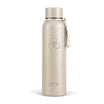


















Cup-holder fit is decided by the outside diameter of the base, not by the widest point of the body. Most car holders accept something under roughly 75 mm at the base, and many older or smaller cars rather less, so 75 mm is a practical ceiling rather than a standard. A tapered tumbler can be wide at the lid and still drop in; a straight-sided one cannot. A silicone boot adds a few millimetres exactly where the holder grips, and a handle often fouls the console before the base is the problem at all. Measure the inside of your own holder with a ruler, and ask the manufacturer for the base diameter in writing.
Key Facts
- A cup holder grips only the lowest few centimetres of a vessel.
- Roughly 75 mm of base diameter is the practical ceiling for most car holders, not a standard.
- A silicone boot adds width in the gripped zone; a lid adds width where it rarely matters.
- A fitted handle can foul a console or gear selector before the base ever becomes the limit.
- On a tapered body, measure diameter at the depth of your holder rather than at the bottom.
Buying rather than reading? HydroPro, ₹1,499. Full reasoning below.
The holder only ever touches the base
A cup holder is a cylinder with a floor. It grips the lowest six to eight centimetres of whatever you drop into it, which means the dimension that decides fit is the outside diameter of the base and the first few centimetres above it. The widest point of the body is irrelevant if it sits above the lip of the holder.
That is the whole reason tapered vessels exist. The designer buys volume high up and narrowness low down, and the result fits a car that a straight-sided equivalent of identical capacity would not.
Why 75 mm is a rule of thumb and not a standard
There is no single cup-holder dimension to design against. Across the cars common on Indian roads, something under roughly 75 mm at the base will go into most holders — and that figure is a practical ceiling, not a specification. Plenty of older and smaller cars are tighter. Some larger vehicles are far more generous. The same model year often differs between the front console and the rear armrest.
So treat 75 mm as the point at which fit stops being safe to assume and starts requiring a measurement. Above it you are gambling; below it you are probably fine but still guessing.
A boot and a lid add width, but check where
Accessories change the geometry, and whether that matters depends entirely on height. A silicone boot wraps the base, so its few millimetres of wall land precisely where the holder squeezes — it is the one accessory that can turn a fit into a non-fit. A lid adds width at the top, which usually changes nothing. A handle is the awkward case: it frequently fouls a console, a gear selector or an armrest long before the base is the constraint, and that failure is far harder to predict from a dimension sheet than from thirty seconds with the actual car.

Measure your own holder in thirty seconds
Lay a ruler across the opening of the holder, inside edge to inside edge, and note the smallest figure across all the holders you actually use. Then measure the depth. Compare the first number against the base diameter of the vessel plus any boot you intend to fit, and the second against how much of the vessel you want supported — a tall tumbler held by only three centimetres will topple on a corner even if it technically went in.
If the vessel tapers, take its diameter at the depth of your holder rather than at the very bottom. That single correction resolves most arguments about whether a given tumbler fits.
What this means for a 1.2 litre tumbler
Large-format tumblers are where this gets tight, because the capacity has to go somewhere. HYV's 1.2 litre line is built on a wide body — the HydroMax product title calls it “Stanley-Style, Wide Body” — and a wide body with a taper can still sit in a holder that rejects a narrower straight-sided vessel of the same volume. The point is that fit cannot be inferred from capacity, from a silhouette or from a photograph.
Ask for the base diameter in millimetres for the exact model you intend to buy, in writing, and hold it against the measurement you took from your own car. That is a thirty-second check that prevents a return.
Disclosure
HYV sells the tumblers used as illustrations here, so read this as a manufacturer explaining a constraint it also has to design around. The thing you can check without us is the one that matters most: the measurement is yours to take, a ruler laid across your own cup holder is a harder fact than anybody's marketing, and it is the number we are telling you to trust ahead of ours. The thing HYV is not the answer for: if your use case needs a 250 ml vessel or a 3 litre one, this range does not extend to either size and no amount of base-diameter detail will change that. HYV also does not publish a wall-thickness figure, so if your specification depends on one, order a sample and measure it.
Related reading: best water bottles for car in india cup holder fit, best tumbler for car in india and 2 litre tumbler india why the range stops at 1 2.
Frequently Asked Questions
What base diameter fits a car cup holder?
Roughly 75 mm or less at the base will go into most car holders, but that is a practical ceiling rather than a standard. Measure your own holder, because older and smaller cars are often tighter.
Does a silicone boot stop a tumbler fitting a cup holder?
It can. A boot wraps the base, which is exactly where the holder grips, so it adds width in the worst possible place. A lid adds width at the top, where it rarely matters.
Do 1.2 litre tumblers fit car cup holders?
It depends on the base diameter and the taper, not on the capacity. Ask for the base diameter in millimetres for the exact model and compare it with your own measurement.
Where should I measure a tapered tumbler?
At the depth of your cup holder, not at the very bottom of the vessel. A tapered body is narrowest at the base and widens as it rises, so the bottom figure flatters it.
Why does my tumbler fit the holder but still feel unstable?
Because depth matters as well as width. A tall vessel supported by only two or three centimetres has most of its mass above the grip and will tip on a corner.
Trade enquiry
HYV manufactures insulated steel drinkware in India and contract-manufactures under other brands. Send a brief and get a quote against a real specification.
Send a manufacturing brief →Minimum 25 units per SKU · custom colourway from 1,000 · 7–14 days from a confirmed brief · UV print or laser etching


Leave a comment
This site is protected by hCaptcha and the hCaptcha Privacy Policy and Terms of Service apply.