












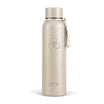


















A collapsible water bottle is a silicone or TPU water bottle that folds flat when empty — great for travel, hiking, and portable use. Sizes 500ml–1L. India price ₹400–1500. Top picks: Nomader Collapsible, Vapur Anti-Bottle, Hydaway. Trade-off: does not insulate; may retain smell over time. For daily use, certified insulated steel wins on specs; for travel weight, collapsible wins.
Key Facts
- Collapsible = silicone/TPU folding bottle.
- India price: ₹400–1500.
- Great for travel/hiking; not insulated.
HYV picks, with the actual product
Three models worth looking at for this, photographed as they ship. Prices are the direct price on livehyv.com.


Free shipping on orders over ₹499 · 7-day free replacement for product issues. HYV makes BIS-certified bottles.
When collapsible works
- Airplane travel (empty through security).
- Hiking (weight savings).
- Emergency backup.
Top picks
Nomader Collapsible, Vapur Anti-Bottle, Hydaway.
Frequently Asked Questions
Are collapsible bottles worth it?
For travel, yes. For daily use, insulated steel is more practical.
Common buying mistakes
- Trusting an uncertified retention claim. If it is not BIS IS 17526:2021 certified, nobody has measured it.
- Buying "double wall insulated" under ₹400. At that price it is usually single-wall steel inside a plastic shell.
- Accepting "SS" or "food-safe steel" as a specification. The grade is the whole point — look for 304.
- Buying too small. A 500ml bottle for an office day means six refills, and almost nobody completes six.
- Ignoring the lid. A screw cap costs you sip frequency every single day.
- Never replacing the gasket — then replacing the whole bottle instead.
How the insulation actually works
Heat moves three ways, and a vacuum bottle blocks each differently. Conduction and convection both need molecules to carry heat — removing the air between the two steel walls eliminates both. Radiation needs no medium, so a reflective copper coating on the outer face of the inner wall bounces it back.
What remains is a slow leak at the neck, where the walls must physically join, and through the lid, which contains no vacuum at all. That is why two bottles with identical vacuum quality can differ by hours: the lid is usually the weakest thermal link.
It also explains three habits that measurably change results: pre-chill or pre-heat the empty bottle for a minute before filling, fill to the top so there is less air inside to convect heat, and keep the lid closed — most heat gain happens at the open neck.
The four checks worth making before you buy
- Steel grade stated explicitly — 304, 18/8 or SUS 304. "SS" or "food-grade steel" without a number usually means grade 201, which pits in water contact.
- Double-wall vacuum construction if you want any temperature retention. Single-wall insulates nothing and sweats in humidity.
- BIS IS 17526:2021 certification with a CM/L number — the only retention claim in India that has actually been tested.
- Replaceable silicone gasket. Gaskets perish within 6-12 months of daily use; a sealed lid assembly means the bottle dies when the seal does.


Leave a comment
This site is protected by hCaptcha and the hCaptcha Privacy Policy and Terms of Service apply.