












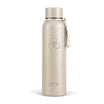


















Every bottle holds water standing upright, so that position tells you nothing. A travelling bottle spends its day on its side, sometimes upside down, pressed against a laptop in a bag, and that is the only position that can cost you anything. So choose a 750ml travel bottle by its lid: a gasketed screw cap is the most tolerant but needs somewhere to put the cap, a flip top opens one-handed but leaves the spout exposed to the inside of your bag, and a chug-plus-sipper lid gives two ways to drink and two more surfaces to keep clean. Then run the only test that matters before you leave: fill it, close it, invert it over a sink and shake hard.
Key Facts
- A travel bottle's seal should be judged inverted and shaken, not standing upright.
- 750ml is one fill for roughly half a day, which means one refill stop rather than three.
- A slim diameter is what lets a 750ml bottle sit in a car or aircraft cup holder.
- HYV's sealed 750ml bottles are rated 24 hours cold and 12 hours hot.
- A spare silicone boot for the base is ₹299 and reduces noise and denting in transit.
The travel test is horizontal
Here is the asymmetry nobody sells on. A bottle standing on a hotel desk is doing nothing difficult; gravity is holding the water away from the lid for you. A bottle in a backpack is lying across your charger, rotating as you walk, occasionally inverted when the bag goes into an overhead bin, with the full weight of the water pressing on the gasket from the inside.
That is the duty cycle to buy for, and you can test it in your own kitchen before you commit to a trip. Fill the bottle to the line, close the lid as you normally would rather than as tightly as you can, hold it upside down over a sink and shake it hard for ten seconds. Then lay it on a dry tea towel for an hour. Anything that fails that was always going to fail in a bag.
Three lid types, three travel behaviours
A gasketed screw cap is the most forgiving design in existence, because the seal is made by compression across a full circle and nothing has to pivot. It is also the slowest to drink from, and the cap has to be held or pocketed every time, which on a crowded train is how caps are lost.
A flip top solves the one-handed problem and keeps the lid attached, but the drinking spout sits exposed to whatever is inside your bag between drinks, so it wants a cover or a clean pocket.
A chug-and-sipper lid gives you a fast opening for thirst and a narrow one for sipping while walking. The cost is two sealing surfaces instead of one, both of which need the same weekly attention.
Whichever you pick, the gasket is the part that ages, and a travel bottle ages faster because it is opened and closed far more often than a desk one. Check it at the start of a trip rather than discovering it halfway through one.
Why 750ml is the travel number
Capacity on a journey is a count of refill stops, not a volume. At 750ml you fill at home or at the airport fountain and you are set for most of a half-day of travelling, which usually means one stop rather than three. At 500ml you are hunting for water at every change. Above a litre the bottle stops fitting the places travel gear is built around: the side pocket of a daypack, the mesh sleeve of a laptop bag, the holder in a seat back.
Diameter does the rest. A slim 750ml body sits in a car cup holder and in the ring in an aircraft tray table; a wide one does not, regardless of how good the insulation is.
What HYV has at 750ml
All of these are sealed formats, so they carry the bottle rating of 24 hours cold and 12 hours hot, which on a long journey means water you poured at dawn is still cold at dinner.
The FlipFlow 750ml at ₹999 is the one-handed option, with a quick-flip lid that stays attached. The SnapSip 750ml at ₹1,499 closes with a magnetic lid, which removes the put-the-cap-somewhere problem entirely. The CoreFlow 750ml at ₹899 is the plain screw-cap version and the one to buy if you would rather not think about a mechanism at all. Choose on which of the three lid behaviours above suits how you actually travel.

Security, ice and the overhead bin
Three practical notes. Go through airport security empty and fill afterwards; a steel bottle is not a problem, a full one is. If you want ice on the journey, you need a mouth wide enough to drop cubes through, and a narrow sipper neck will not take them, so decide that before you buy rather than at a hotel ice machine.
And consider the base. A bare steel bottle rolling in an overhead bin is loud and dents at the rim, which is where a bottle starts to look old. A silicone boot stops both; a spare one is ₹299. It also stops the bottle skating across a tray table every time the vehicle turns.
Finally, think about where the bottle rides. In an outside mesh pocket it is quick to reach and easy to leave behind at a security check or on a train seat; inside the bag it is slower to get at and far more likely to come home with you. Most people lose travel bottles rather than wear them out.
Disclosure
HYV makes and sells all three of the bottles named above, so the lid comparison comes from someone with lids to sell. The claim you can settle without us is the seal, and it takes thirty seconds: invert a filled bottle over your own sink and shake it before any trip. No specification sheet or review outranks that result on the bottle actually in your hand.
HYV is not the answer if you want a soft flask or a hydration bladder that packs flat when empty. Everything in this range is rigid steel, and for trekking where packed volume matters more than retention, a collapsible bottle is the better tool.
Related reading: how long insulated bottle keep water cold, best insulated bottle under 1000 india and best insulated bottle under india.
Frequently Asked Questions
How do I know if a travel bottle really leaks?
Fill it, close the lid normally, invert it over a sink and shake hard for ten seconds, then lay it on a dry towel for an hour. That reproduces how it sits in a bag, which upright testing never does.
Is 750ml a good size for travel?
Yes for most journeys. It covers roughly half a day in one fill, so you stop once rather than repeatedly, and a slim 750ml body still fits cup holders and bag pockets.
Which lid type is best for travelling?
A screw cap seals most reliably but must be put down to drink. A flip top is one-handed but leaves the spout exposed in a bag. A chug and sipper lid is versatile but has two sealing surfaces to clean.
How long does an HYV 750ml bottle keep water cold?
HYV rates its sealed bottles from 750ml to 2L at 24 hours cold and 12 hours hot, so water poured in the morning is still cold at the end of a travel day.
Do I need a silicone boot for a travel bottle?
It is optional but useful. It stops the base denting and quietens a bottle rolling in an overhead bin or sliding on a tray table. A spare boot is ₹299.


Leave a comment
This site is protected by hCaptcha and the hCaptcha Privacy Policy and Terms of Service apply.