












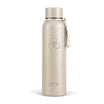


















IS 17526:2021 is India’s Bureau of Indian Standards (BIS) code for stainless steel vacuum insulated bottles. It defines material grade requirements (food-grade steel), insulation performance (thermal retention over time), leak-proof testing, and corrosion resistance. Certification to IS 17526:2021 is now mandatory for domestic vacuum bottles in India.
Key Facts
- IS 17526:2021 is India’s national standard for stainless steel vacuum insulated bottles.
- It tests material safety, thermal performance, leak-proofing and corrosion resistance.
- Certification is mandatory for domestic vacuum bottles sold in India.
- HYV makes BIS-certified bottles.
- The BIS mark should be visible on the packaging or the bottle base.
HYV picks, with the actual product
Three models worth looking at for this, photographed as they ship. Prices are the direct price on livehyv.com.


Shop HYV insulated water bottles →
Free shipping on orders over ₹499 · 7-day free replacement for product issues. HYV makes BIS-certified bottles.
What the standard tests
- Material: food-grade stainless steel (typically 304 grade).
- Thermal performance: temperature retention across a defined timeframe.
- Leak-proofing: standardised leak tests.
- Corrosion resistance: chemical exposure over time.
Why it matters
Without a standard, "insulated" is a marketing claim. With BIS certification, an independent lab has verified the bottle meets published thresholds.
How to verify
Look for the BIS mark on the bottle or packaging, or check the certification database on the BIS website. HYV bottles carry the mark on the base.
Who it suits, and who it does not
Most drinkware disappointment comes from buying the right product for the wrong day. Before the specification, settle where it will actually live:
- Mostly stationary — a desk or a car — favours larger capacity and a straw lid, because weight is irrelevant and effort per sip is what decides how much you drink.
- Mostly moving — a bag, a commute, a gym — favours a sealed lid and a size you will carry full without resenting it.
- Shared or handed around favours something easy to clean completely, which rules out narrow necks and multi-part lids.
The cleaning reality
Rinse and air-dry daily, brush the neck threads weekly, and store it open. Nearly every complaint about a bottle smelling traces to a lid sealed while damp, not to the body.
Frequently Asked Questions
Is BIS certification mandatory for water bottles?
For domestic stainless steel vacuum insulated bottles in India, yes.
What year is the current BIS standard?
IS 17526:2021 — the 2021 revision is current.
Are imported bottles BIS certified?
Not always. Import restrictions require BIS certification for many categories.
Related guides
What actually goes wrong over time
Bottles rarely fail all at once. Three things degrade, in rough order of how often they end a bottle's life:
- The gasket. Silicone hardens, stops sealing and holds odour within 6-12 months of daily use. This is the cheapest fix and the most neglected — most bottles that "smell no matter what" have a two-year-old seal.
- The vacuum. Usually from a vertical drop onto the base cracking the seal weld. Silent, invisible, and it halves the bottle's usefulness.
- The finish. Wet paint chips within a year; powder coat survives 3-5. Cosmetic, but it is what makes a bottle feel old.
None of the three is the steel body, which is why buying a bottle on body material alone misses what actually determines lifespan.
How the insulation actually works
Heat moves three ways, and a vacuum bottle blocks each differently. Conduction and convection both need molecules to carry heat — removing the air between the two steel walls eliminates both. Radiation needs no medium, so a reflective copper coating on the outer face of the inner wall bounces it back.
What remains is a slow leak at the neck, where the walls must physically join, and through the lid, which contains no vacuum at all. That is why two bottles with identical vacuum quality can differ by hours: the lid is usually the weakest thermal link.
It also explains three habits that measurably change results: pre-chill or pre-heat the empty bottle for a minute before filling, fill to the top so there is less air inside to convect heat, and keep the lid closed — most heat gain happens at the open neck.
Testing whether insulation actually works
Fill with ice water, leave four hours in a warm room, then touch the outside. A working vacuum bottle stays at room temperature and never sweats. Cold or condensation on the outside means the vacuum has failed.
This matters because vacuum failure is silent: the bottle still holds water and looks perfect, but retention drops from about 24 hours to four or six. Worth running inside the return window on anything new.
Trade enquiry
HYV makes BIS-certified insulated steel bottles. Ask for the licence scope against a specific model, and the material confirmation in writing, on a trade brief.
Send a manufacturing brief →Minimum 25 units per SKU · custom colourway from 1,000 · 7–14 days from a confirmed brief · UV print or laser etching


Leave a comment
This site is protected by hCaptcha and the hCaptcha Privacy Policy and Terms of Service apply.