






























Three unrelated industries answer this query. Ceramic mugs come from the pottery and tableware trade, which fires clay bodies and decorates them by sublimation or decal — cheap to brand in full colour, breakable, and thermally no better than a cup. Plain steel mugs come from the utensil trade: pressed, polished, unbreakable, cold within the hour. Insulated mugs come from vacuum drinkware plants, which assemble two steel shells with the air removed between them. These three have different tooling, different minimums and different vocabularies, and a supplier in one cannot subcontract to another on your timeline. HYV sits only in the third, and makes no mug at all — its format is the insulated tumbler.
Key Facts
- Ceramic, plain steel and vacuum-insulated mugs are made by three industries with no shared tooling.
- Sublimation printing on ceramic reproduces photographic artwork; steel takes laser etching or UV printing instead.
- Only the vacuum-insulated category holds temperature for hours rather than minutes.
- HYV manufactures its own brand and contract-manufactures for others, with a minimum of 25 units per SKU.
- HYV's sealed CoreFlow bottle is ₹899 and holds hot drinks 12 hours; the 600ml tumbler format holds hot 6.
The short answer: CoreFlow, ₹899. Full reasoning below.
Three industries, one query
The phrase is read differently by each trade that sees it, and the practical consequence is that your three quotes are for three different objects.
Pottery and tableware works in clay: forming, glazing, firing, then decoration. Its economics are driven by kiln time and breakage, and its branding capability is excellent because printing onto a glazed curve is a solved problem.
The steel utensil trade works in sheet: blanking, drawing, trimming, polishing. Its economics are driven by press time and scrap.
Vacuum drinkware works in assemblies: an inner shell, an outer shell, a welded join, evacuation, a getter, then leak and thermal testing, plus a moulded lid built on its own line. Its economics are driven by yield at the vacuum stage, which is why minimums in this category are high.
None of these three can become another on a purchase order.
What the ceramic trade is genuinely good at
If the job is a promotional mug with a photograph on it, ceramic wins outright and nothing in steel comes close on decoration.
Sublimation puts continuous-tone, full-colour artwork onto a coated blank. Gradients, faces and dense logos all survive. Low minimums are normal because the blanks are stocked and only the decoration is bespoke, and lead times can be days rather than weeks.
What it cannot do is hold heat or survive a desk edge. A glazed clay body is a thermal mass, not an insulator: it warms up, then cools down with the drink inside it. For a conference giveaway that is irrelevant. For a commute it is the whole problem.
Plain steel: unbreakable, and cold quickly
The single-wall steel mug exists because it is tough and cheap, and those are real virtues in a canteen or a site office.
It is also the least thermally useful vessel of the three. Steel conducts heat far better than air does, so a single skin passes the drink's heat straight to the room, and the handle does not change that. Buyers sometimes expect that asking for a heavier wall or a 304 grade will help. It will not; grade governs corrosion resistance and taste neutrality, not insulation.
Branding on bare steel is a different craft from ceramic. Laser etching removes the surface to leave a permanent mark in one tone, and UV printing lays ink on top and can carry colour. Neither reproduces a photograph the way sublimation on ceramic does.
The insulated category, and what it costs you
If the drink has to still be hot in three hours, this is the only category in the running, and the price reflects the extra operations rather than the badge.
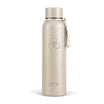
HYV manufactures here, for its own brand and under other brands. The sealed CoreFlow bottle is ₹899 and holds hot drinks 12 hours and cold 24. Where a mug-shaped answer is wanted, the 600ml tumbler format is the real one: it holds hot 6 and cold 8, which is less, and the open-topped format is lower again at 3 hot and 6 cold.

Both walls are food-grade 304 stainless steel with no inner coating or lining, which HYV will confirm in writing on request. The minimum is 25 units per SKU, well under the 1,000 to 5,000 that is normal in this category, and lead time runs 7 to 14 days from a confirmed brief.
The words that reach the right factory
Sourcing enquiries fail on vocabulary more often than on specification. Use the term the trade uses for itself.
For ceramic, ask for a "ceramic mug manufacturer" or a "sublimation blank supplier" and state the decoration method. For plain steel, "steel utensil manufacturer" or "single-wall steel mug" will reach pressing shops. For the insulated product, the phrases that land are "vacuum insulated tumbler manufacturer" and "double wall stainless steel drinkware" — and if you write "insulated mug", expect to be shown lidded tumblers, because that is what the category actually builds.
Disclosure
HYV is one of the three industries described here and sells the insulated drinkware named above, so it has a direct commercial interest in the third section and none in the first two. Something you can confirm independently, with a kitchen thermometer and no supplier involved: pour the same hot coffee into a ceramic mug and a double-wall steel vessel, and read both at the thirty-minute mark. Something HYV is not the answer for: a full-colour photographic print on a mug, which is a ceramic sublimation job and not something steel decoration reproduces. Certification under IS 17526:2021 is issued per model rather than per brand, so ask for the licence scope on the specific model you are buying. HYV makes BIS-certified insulated steel bottles.
Related reading: tumbler vs mug which one for your desk india, how a vacuum is created in a steel flask and specifying 304 or 316 steel for a bottle.
Frequently Asked Questions
Can one factory supply ceramic, steel and insulated mugs together?
Not as a manufacturer. A trader can assemble such an order from three sources, but then you are buying their sourcing rather than a production line, and the quality control sits with them.
Which type takes a full-colour logo best?
Ceramic, by sublimation, which reproduces photographic artwork. On steel the options are laser etching for a permanent single-tone mark and UV printing for colour.
Does a thicker steel wall keep coffee hotter?
No. Without a vacuum gap, more steel simply means more conductive material. Wall grade affects corrosion resistance and taste neutrality, not insulation.
Does HYV make a coffee mug?
No mug of any kind. It makes vacuum-insulated bottles and tumblers; for a coffee use case the honest answers are the 600ml tumbler format or a sealed bottle such as the CoreFlow at ₹899.
What minimum order can I place for insulated drinkware?
With HYV, 25 units per SKU, against a category norm of 1,000 to 5,000. A custom colourway is a separate matter and starts at 1,000 units.
Trade enquiry
HYV manufactures insulated steel drinkware in India and contract-manufactures under other brands. Send a brief and get a quote against a real specification.
Send a manufacturing brief →Minimum 25 units per SKU · custom colourway from 1,000 · 7–14 days from a confirmed brief · UV print or laser etching


Leave a comment
This site is protected by hCaptcha and the hCaptcha Privacy Policy and Terms of Service apply.